Visible mess and logical difficulty are different
Several meetings competing for the same time make a calendar look busy. But if each movable meeting has an obvious empty destination, the board may be straightforward to solve. The number of overlaps describes the starting mess; it does not describe every decision required to clear it.
Conversely, a board with fewer conflicts can require more planning when the needed destinations are occupied or split by locked events. To understand that difference, look at what restricts the placements rather than only how crowded the screen appears.
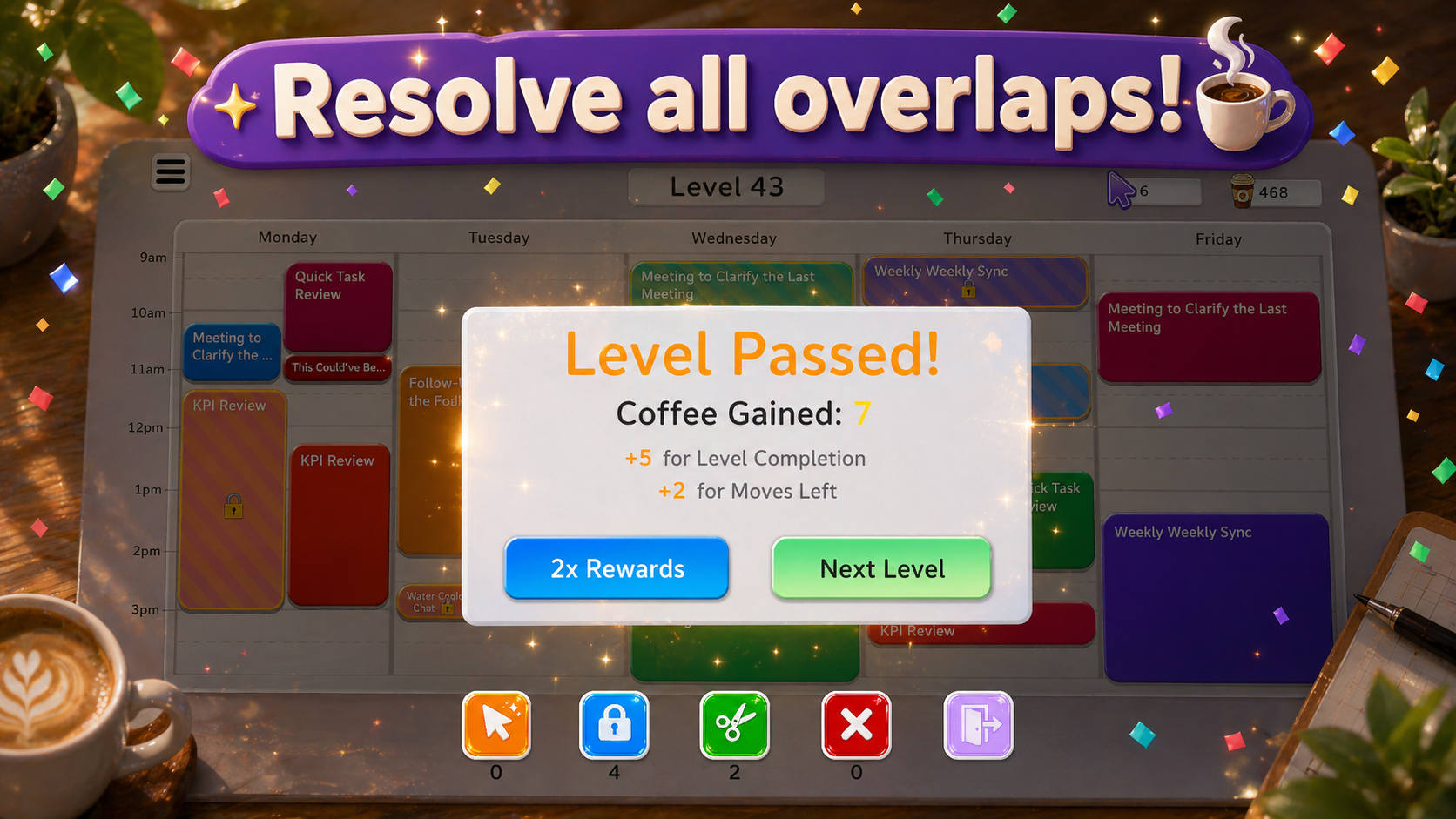
Duration changes the number of possible placements
Meetings keep their duration when dragged. A short block can fit into a gap that cannot contain a longer one. A long meeting may therefore have fewer possible destinations even when there is plenty of empty time overall.
This is why counting free hours alone misses part of the problem. Free time split across several small gaps is not equivalent to one continuous opening. The shape of the empty space matters as much as its total amount.
At the design level, different meeting lengths produce different placement choices. If all pieces can fit almost anywhere, destinations are easy to exchange. When some pieces fit only in particular gaps, choosing where another piece goes has greater consequences.
Locked events change the shape of the day
A locked meeting cannot be moved by ordinary dragging. Its position divides the surrounding time into fixed regions. Moving other meetings does not join those regions into a single larger gap.
The same amount of occupied time can produce different puzzles depending on its position. A fixed event near a boundary leaves one shape of free space; a fixed event in the middle leaves another. That distinction affects which durations can be placed without conflicts.
Some moves depend on other moves
A meeting may need a destination currently occupied by a different unlocked meeting. That second meeting needs somewhere to go first. Planning now involves a sequence of placements instead of one isolated choice.
A currently non-overlapping meeting can be part of that sequence. It is not necessarily settled forever just because it looks correct at the start. Its space may be needed by a block with fewer alternatives.
This is the distinction between spotting a free gap and creating one. The overlap-solving guide covers how to use that distinction during play. Here, it explains why two equally crowded boards can require different amounts of reasoning.
More days change the choices, not just the size
Meeting Mayhem calendars can show up to five days and eight hours per day. Additional day columns give unlocked meetings more places to move, but also ask the player to consider destinations beyond the day containing the original conflict.
A larger board is not automatically more difficult. Extra space can provide an easy alternative. Its effect depends on how that space is distributed and whether it fits the meetings that need it.
A move budget adds another constraint
On a level with a move limit, reaching a conflict-free arrangement is only useful if you can do it within the available moves. A rearrangement with unnecessary detours can run out of budget even when a more direct sequence exists.
Meeting Mayhem’s mobile level-design tools assess difficulty using solution depth alongside the starting overlaps and pressure from the move budget. This gives a fuller view than meeting count alone. The design question becomes how much rearrangement a solution needs, not simply how much clutter can be added.
How to read that difficulty as a player
Look for meetings with scarce destinations, fixed boundaries and placements that depend on another move. Those details explain why a board needs thought before dragging. They also explain why a long meeting does not always move first: its destination may need to be opened by a shorter block.
For the basic rules, read how scheduling puzzles work. For the origin of this calendar format, read the story behind Meeting Mayhem. You can play the mobile game on Google Play.