The moment behind the idea
The inspiration came from looking for a time to arrange a meeting at work. The calendar was already heavily filled. Finding room meant looking at occupied time, comparing gaps and checking where another event could fit.
That was the part worth turning into a puzzle. The calendar already gave the problem a visible structure: days, hours, event lengths and collisions. A crowded schedule could become a board with a clear task for the player.
Turning occupied time into puzzle pieces
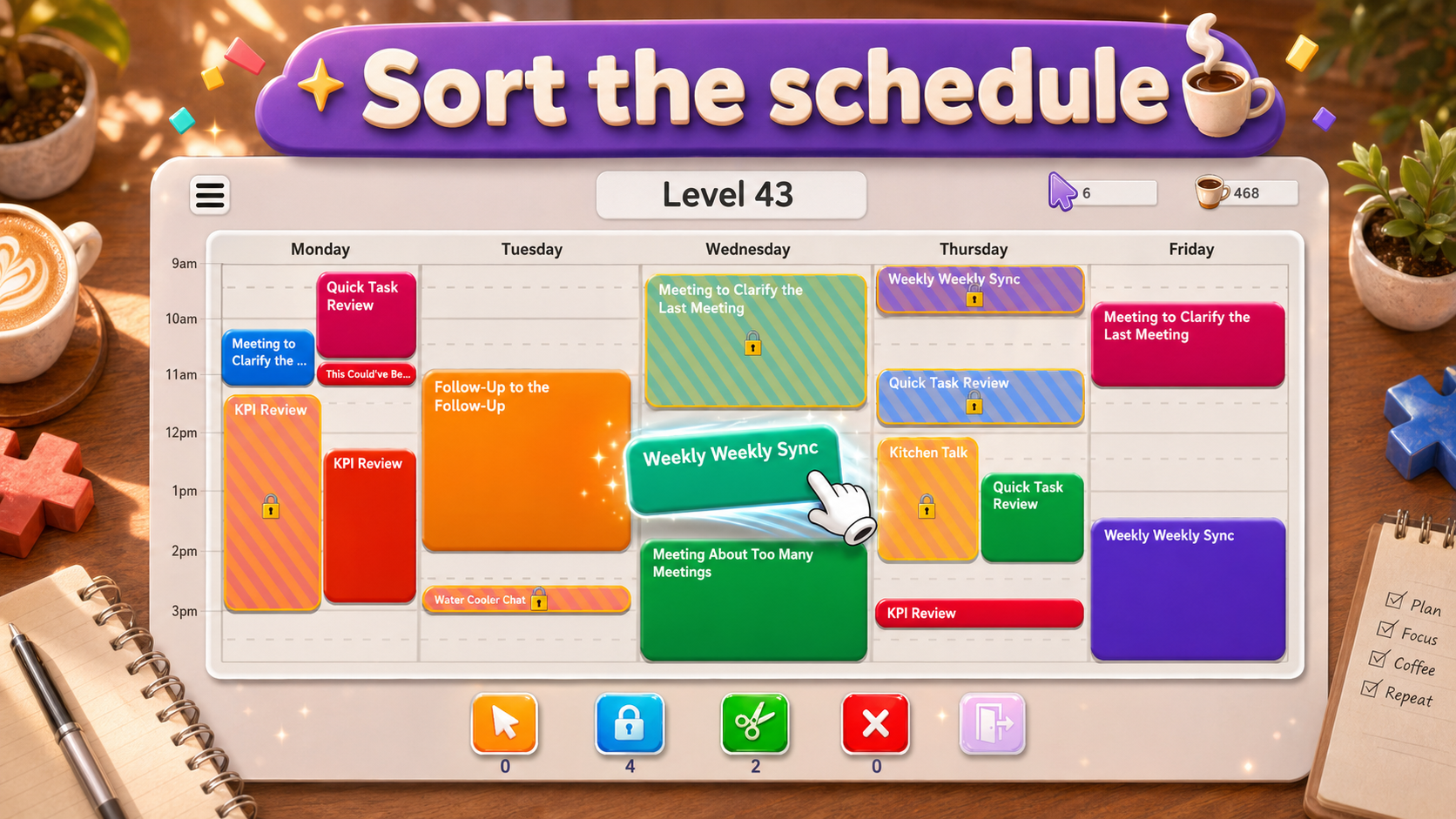
In the mobile game, unlocked meetings become the pieces you can move. Locked meetings stay where they are. The player drags movable events into free space, and the level ends successfully when every overlap has been resolved.
The calendar’s size makes those decisions matter. Boards can show up to five days and eight hours per day, with each level defining its available space. Moving a meeting does not create extra hours. It changes how the existing hours are used.
Meeting duration matters for the same reason. A block needs a continuous gap that can contain its full length. Dragging it somewhere else keeps that length intact. A day with plenty of scattered free time may still have no suitable home for a long meeting.
A clear finish for a familiar problem
At work, arranging a meeting involves people and their availability. Meeting Mayhem keeps the spatial scheduling problem and gives it a defined finish. When the meetings no longer overlap, the board is solved.
This makes the calendar more than a visual theme. Event lengths and occupied time shape the available moves. An unlocked meeting can move to another day, while a fixed event forces the player to plan around it. Those are the decisions at the centre of the game.
Developing the game toward hybrid-casual
As the idea developed, the direction shifted from a casual puzzle toward a hybrid-casual mobile game. The familiar drag-and-drop puzzle remained at the centre, with additional systems around level play.
Two additions were the Lucky Spinner and daily tasks. The spinner adds a reward interaction. Daily tasks give players goals alongside solving calendar boards. They provide more to do across sessions while leaving the puzzle’s objective intact.
Here, “hybrid-casual” describes that design direction: a straightforward core interaction supported by progression, goals and rewards. It is not a different rule for moving meetings. The calendar still has to end without conflicts.
A calendar with a tactile feel
The mobile game pairs the calendar with wooden-style sounds when meetings are picked up and dropped, plus Lo-Fi background music. On supported devices, haptic feedback adds a physical response to interactions. Players can turn haptics off in Settings.
These details give moving an event a different feel from editing an appointment in a work app. The board remains a schedule you can read, while sound and touch feedback mark the actions you take on it.
Try the mobile game
For the controls, read the Meeting Mayhem gameplay guide. For help planning moves, read how to solve overlapping meeting puzzles. The mobile game is available on Google Play.