What does “calendar puzzle game” mean?
The phrase can describe different kinds of puzzles. In a digital scheduling puzzle, the board is a calendar and the pieces are events that occupy time. A physical calendar puzzle may instead ask you to arrange shapes around a particular date. The shared calendar theme does not mean they have the same rules.
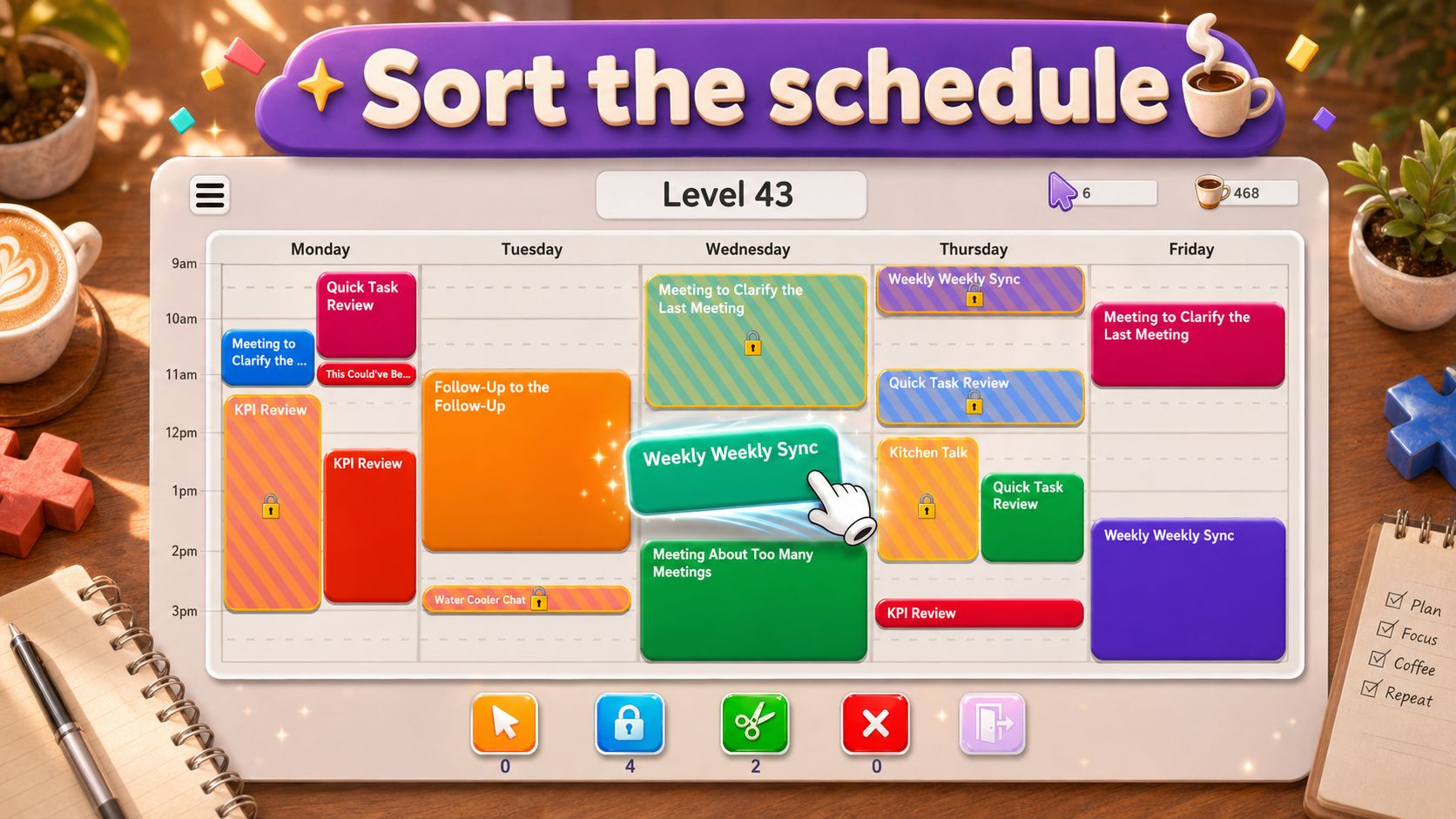
This guide focuses on scheduling puzzles, using Meeting Mayhem for Android as the example. Its calendar is crowded with meetings. You move the unlocked ones to find an arrangement where no meetings overlap.
How the calendar becomes the board
Each day provides a column of available time. A meeting occupies a continuous part of that day, and its duration determines how much room it needs. An empty area is useful only if the whole meeting fits there.
Meeting Mayhem boards can span up to five days, with up to eight hours shown per day. Individual levels use smaller or larger calendars within those limits. These hours describe the space on the board, not an eight-hour countdown for the player.
The rules in Meeting Mayhem
- Move unlocked meetings. Drag them to another time or another day shown on the board.
- Keep their duration. Dragging changes a meeting’s position, not its length.
- Work around locked meetings. They cannot be moved by dragging.
- Use the calendar grid. Positions snap to 15-minute intervals, and the whole meeting must stay within the board.
- Clear every overlap. The level is solved when all meetings fit without conflicts.
A drop can leave meetings overlapping. That does not solve the conflict, even if the block has moved. On a level with a move budget, the useful question is what a move makes possible before you run out of moves.
Why an empty gap may not be enough
Available time and usable space are different. Two separate half-hour gaps do not provide one continuous hour for a meeting that lasts an hour. A locked event between them divides the space, and dragging does not split the meeting into pieces.
The same idea explains why the first open slot is not always the best destination. A short meeting might fit into several gaps, while a longer one has only one possible home. Filling that home too early can leave the longer meeting without a place.
Checking other days matters too. A crowded day does not have to keep every meeting it started with. Moving an unlocked meeting to another day can free the continuous space needed by the remaining blocks.
How this differs from a calendar app
A calendar app helps manage real appointments, attendees and reminders. Meeting Mayhem gives you an authored puzzle with a clear finish: no overlaps. You do not need to invite coworkers or connect a work calendar to understand the board.
The idea came from trying to arrange a meeting around a heavily filled work calendar. Our account of how Meeting Mayhem took shape explains how that situation became a mobile puzzle and why daily tasks and the Lucky Spinner were added around it.
Where to start
Read the gameplay guide for the controls and first-session basics. If you already understand the rules, the overlap-solving guide focuses on choosing where meetings should go.
Meeting Mayhem is available as a free download on Google Play.